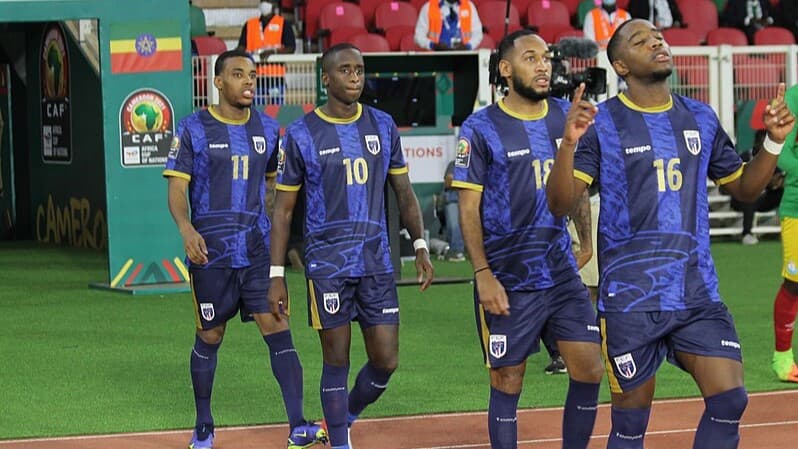
When Cape Verde's national football team, known as the Blue Sharks, secured their place at the FIFA World Cup, the achievement reverberated far beyond the ten islands that make up this small Atlantic archipelago. A nation of fewer than 600,000 people, spread across volcanic terrain with limited domestic football infrastructure, had punched through barriers that once seemed immovable — and in doing so, offered a compelling story about what persistence, diaspora talent, and continental development can accomplish together.
A Nation Built for Football — Eventually
Cape Verde's relationship with football has always been passionate, if logistically complicated. The country's geography — islands separated by open Atlantic waters — has historically made domestic league competition challenging to organise at scale. Yet football has long served as a cultural anchor, with communities on islands such as Santiago, São Vicente, and Sal developing deep footballing traditions rooted in local pride.
What transformed Cape Verde's competitive potential was the strategic harnessing of its diaspora. Large Cape Verdean communities settled across Portugal, the Netherlands, France, and the United States over generations, and many of their descendants developed into professional footballers competing at the highest levels of European club football. Cape Verde's football federation made the deliberate and ultimately decisive choice to recruit eligible players from these communities, blending diaspora talent with home-grown development to build a squad capable of competing on the continental stage.
The Road Through African Qualification
Africa's World Cup qualification pathway, administered through the Confederation of African Football (CAF), is among the most competitive in global football. The continent's qualification rounds pit nations against each other in group stages and knockout rounds, with only a limited number of berths available at the finals. For smaller nations, navigating this process requires consistent performances against opponents who often have significantly larger populations, deeper domestic leagues, and greater financial resources.
Cape Verde's qualification journey reflected the maturation of a programme that had been quietly building momentum across successive tournaments. The Blue Sharks had previously demonstrated their quality in Africa Cup of Nations campaigns, reaching the knockout rounds and announcing themselves as a side capable of competing with established continental powers. Each tournament cycle added experience, cohesion, and belief — the intangible currencies that eventually translate into historic breakthroughs.
What the Qualification Signals for African Football
Cape Verde's World Cup debut carries significance that extends well beyond national celebration. It reinforces a broader truth that has been gathering evidence across recent decades: African football's competitive depth is expanding, and the traditional hierarchies of the game are becoming more fluid.
The African continent has seen a growing number of nations develop sustainable football programmes supported by investment in youth academies, improved coaching infrastructure, and stronger domestic leagues. Governing bodies including CAF and FIFA have channelled development funding into member associations across the continent, and the results are increasingly visible at senior international level. Cape Verde's achievement stands as evidence that this investment cycle, when combined with diaspora integration and federation ambition, can deliver transformative results even for the smallest member states.
The Economic and Social Ripple Effects
World Cup qualification carries consequences that reach well beyond the pitch. For Cape Verde, hosting international attention brings opportunities across tourism, national branding, and youth inspiration. The islands are already recognised as a destination of growing appeal, and the visibility generated by World Cup participation provides a platform that conventional marketing budgets could rarely purchase.
Domestically, the qualification is expected to accelerate interest in youth football development, with families and communities more motivated than ever to invest time and resources in the game. This kind of organic growth — driven by a visible, relatable success story — is precisely the foundation upon which sustainable football ecosystems are built.
A Model Worth Studying
Other smaller African football associations will be watching Cape Verde's journey with considerable interest. The Blue Sharks' model — combining diaspora recruitment, strategic federation planning, and consistent continental competition — offers a replicable framework for nations facing similar structural challenges. It demonstrates that population size and domestic league depth, while relevant, are not the sole determinants of international footballing success.
Cape Verde's story also highlights the value of patience and long-term thinking in football development. Progress was not instantaneous; it was the product of incremental improvements across multiple cycles, each building on the last. That kind of sustained commitment, supported by both federation leadership and player dedication, ultimately delivered a moment the entire archipelago will carry forward for generations.
As the Blue Sharks prepare to compete on the world's largest footballing stage, they carry with them not only the hopes of Cape Verde's scattered island communities but also a proof of concept that speaks to the possibilities available to African football in its entirety. The World Cup debut of a ten-island Atlantic nation is, in many ways, a beginning rather than an endpoint — a signal that the continent's footballing map is still being drawn.
Sources: Confederation of African Football (CAF) · https://www.cafonline.com | FIFA — Member Associations · https://www.fifa.com/associations | Cape Verde Football Federation (FCF) · https://www.fcv.cv | World Bank — Cape Verde Country Overview · https://www.worldbank.org/en/country/caboverde | United Nations — Small Island Developing States · https://www.un.org/ohrlls/sids


